
MEGAN MENSINGER ’28
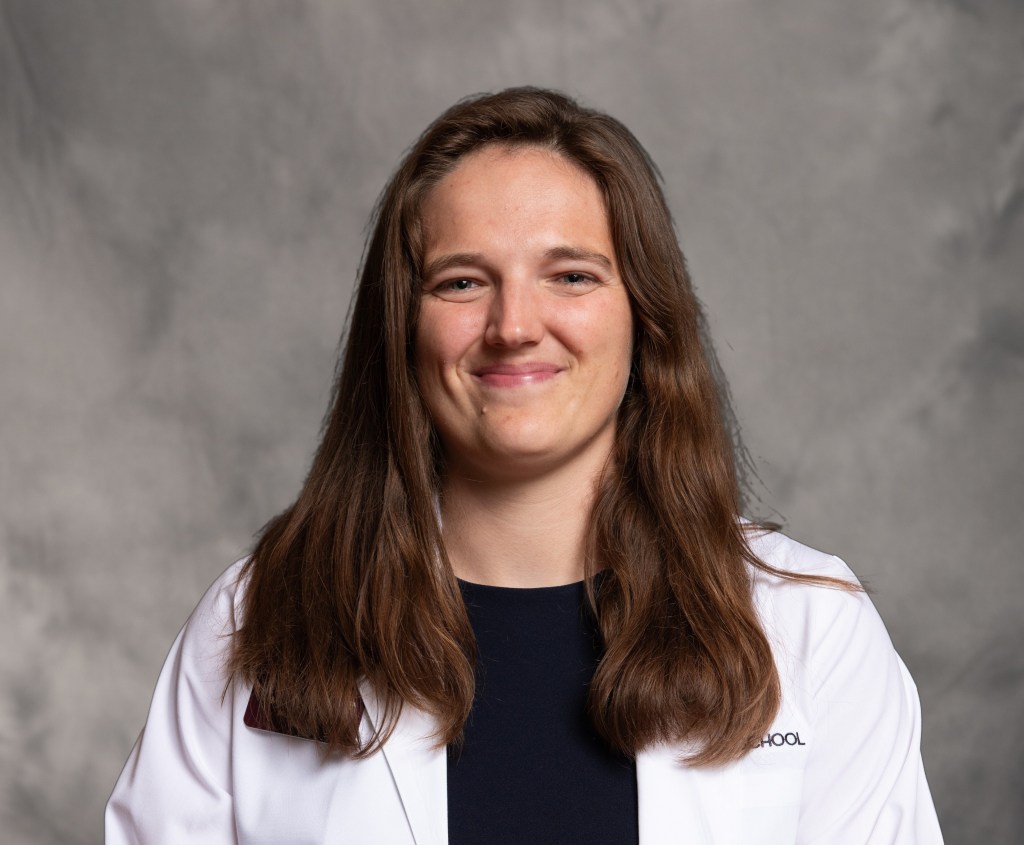
Trabeculae: Hi Megan! I’m glad to be able to keep doing these interviews outside on these warm fall days. Why don’t you tell us a bit about yourself?
Megan: Hello! I’m a 2nd-year medical student from northern Minnesota. I’m a big fan of large bodies of water: I grew up not far from Lake Superior and would spend summers on the East Coast in Cape Cod because my dad is a marine biologist who did research out there. So, I consider the North Atlantic to also be part of my home.
Trabeculae: We will absolutely get into the topic of water and artistic inspiration. But first, what kind of art do you do?
Megan: My main form of art is writing, usually poems and short stories. I’ve been getting more into essays and narrative writing, especially narrative medicine and medical storytelling.
Trabeculae: Have you done creative writing for a long time?
Megan: I’ve always loved reading and writing, but the big catalyst for my writing was deciding to go to New York University for college. I quickly figured out that Manhattan wasn’t the right fit for me and I ended up transferring schools. When I started at Truman State, a lovely little university in Northern Missouri, I was still recovering from New York and wanted to take a creative writing class and just do something that I really enjoy. I had a professor there who was supportive of me processing my experience through writing, and from there on I got the support and mentorship I needed to take my writing more seriously.
Trabeculae: Processing real-world events through writing can be so good for catharsis. Is that a function that writing still serves for you?
Megan: For sure. If there’s something I’m thinking about or trying to process, I’ll open the Notes app on my phone and write down pieces of phrases that come to mind, perhaps the beginning of a poem or story. But some of the stuff I write is really just for fun.
Trabeculae: Tell me a little bit more about your creative process and how that might look different now that you’re in medical school compared to before.
Megan: A big part of my process—or my muse, if you believe in muses—relates to swimming. I was a distance swimmer in college and swimming is still a huge part of my life. The connection to water and the intensity of competing in a sport that I love, all while being intellectually stimulated by my classes, was the perfect setting in which to write. I would show up to class and write in my notebook during the 10 minutes before class started. After I graduated, I took a medical scribing job that ended up being incredibly draining. Ironically, I developed writer’s block during that job, even though I was writing medical notes all day.
Trabeculae: That must have felt very frustrating. Were you able to find any relief from that?
Megan: Well, I knew that with some of the horrific things I was seeing every day, as well as the passivity of my role as essentially a fly on the wall, that eventually I would need to process some of what I’d seen. Once I left that job, I was able to start writing again. And now in medical school, I prioritize going to the pool and swimming, plus I have that intellectual stimulation from our coursework. Although I don’t have as much time to write as I did in college, I do find myself able to write here and there.
Trabeculae: Do you ever force yourself to write? Say, you’re going to write a certain number of words or pages each day, regardless of inspiration?
Megan: I’ve never done anything like NaNoWriMo [an annual creative writing challenge involving writing a 50,000-word novel draft in one month], if that’s what you mean. I usually have multiple pieces I’m working on that I jump between. I never give myself word count requirements. It doesn’t work for me.
Trabeculae: How do you handle having multiple works in progress?
Megan: If I get stuck on one piece, I just go to a different piece. I’m also the sort of person who can read multiple books at once, although I’m haunted by the list of books I’ve started and never finished. I should probably just let that go. This is kind of egotistical, but I usually read through my own work when I’m preparing to write, and sometimes I’ll think, ah, I like where this one was going but it needs work.
Trabeculae: Let’s go back to your inspiration. Besides water and coastal life, are there other themes or ideas that you like to explore?
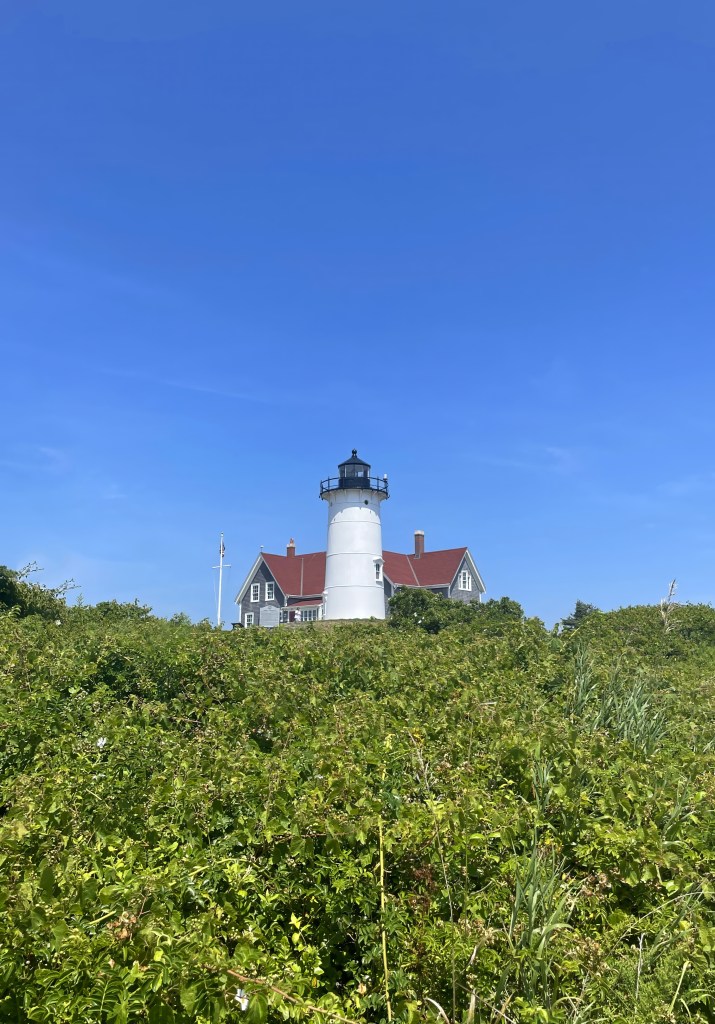
Megan: That’s a really good question. I used to think that I was eventually going to get a PhD on some obscure organism, because I grew up around science. But ultimately, what has always held my attention is the human experience. People fascinate me, as do deep ethical questions about humanity. Medicine is full of those questions, so a lot of the themes in my writing have to do with that intersection of science and humanity.
Trabeculae: That reminds me of classic science fiction, at the core of which is that messy and beautiful (and often terrifying) human element.
Megan: Right. Some of my own pieces lean a little bit in that direction, and I’ve been inspired by magical realism and New Fabulism, too. In my short stories, I might try to come up with some interesting premise. Say, a futuristic aquarium—I love marine creatures, after all—but the whole point of it is to frame the interaction between characters. Bringing in these themes of science or medicine ultimately helps me explore human relationships and how we interact with the world.
Trabeculae: Have you noticed any change in your writing over time?
Megan: For one, I think I’ve learned to write more realistic dialogue. I used to ignore dialogue entirely because I didn’t know how to write it. I thought, well, my characters don’t really need to talk to each other. They’ll just have big internal thoughts. That made sense in the context of how I see myself as a writer, which is as a poet first and a prose writer second. Sometimes I’ll sacrifice the overall story flow for a really good, descriptive line, which then sounds overwritten. I rely heavily on people whose writing I respect to help me edit my writing, which is one way that our Center for the Art of Medicine has been helpful.
Trabeculae: How does your process differ in writing short stories versus poetry?
Megan: I don’t feel that writing poems takes me very much time. I’m not saying they’re all good, but to spit out a poem, and then play around with it like it’s a jigsaw puzzle? That’s not too time-consuming. I don’t perseverate much on my poems once they’re written, but I do think about them a lot before I write them down. Poems are great for my commitment issues.
Trabeculae: Commitment issues?
Megan: Yeah. I would love to write a novel, but I haven’t found a story I want to sit with for months or years. Poetry feels like a more contained moment. I’m also really bad at transitions when I write prose, whereas in poetry I think I can get away with that more.
Trabeculae: Right. In prose, your reader is more likely to get lost if you don’t use transitions.
Megan: That’s a great point. Sometimes I just don’t want to do the telling, because I already know the story in my head and I don’t want to sacrifice, say, descriptive imagery. That’s one trade-off you have to make.
Trabeculae: Do you adopt any sort of authorial persona in your writing?
Megan: Not really, although now I think about how any published work would reflect the profession and myself. I want to make sure I’m always respecting my patients and colleagues, but that should be true regardless of what field you’re in. Part of that is not telling other people’s stories unless you have explicit permission from them. But in terms of authorial persona, I still feel like I’m writing as myself. My poems tend to be about my own thoughts and experiences and help me work through things stuck in my mind.
Trabeculae: The lyrical I is such a great vehicle for poetic self-expression. Do you ever do anything similar in your prose? I’m thinking specifically about autofiction and how that genre has exploded over the last few decades.
Megan: Could you remind me how you would define autofiction? Because it gets a little murky.
Trabeculae: In the broadest strokes: stylized and fictionalized autobiography.
Megan: Okay, I get it. My narrative medicine essays are not like that. Those are nonfiction. And my short stories, although they might be inspired by my experiences, contain completely fictional characters. My poems are much more about my own thoughts and experiences. Some of them are a little bit more out of left field and not really about me, but usually I’m using them to work through things that I’m thinking about.
Trabeculae: It sounds like you do have a strong poetic persona.
Megan: I definitely have a poetic persona. But now that I think about it, you’d pick up on personas in my short stories, too. I always like to have an elderly woman character who’s as direct as I am. I sometimes have trouble switching voices. I’ve been trying to work on that with another short story, in the sense of having the main character’s voice be less like my own. It’s been fun to play around with that because I love a strong, interesting voice from a character from whom you might not expect that. I have a lot of respect for writers who’ve done that, and it makes me think, wow, how did they even dream up this character’s voice? I would like to do a little bit more of that.
Trabeculae: How often, if at all, are you thinking about reader response to your writing?
Megan: Oh, this is really interesting. So, something I’ve noticed is that I’m not a super emotive person. And because of that, writing allows me to express myself in a way that I can’t in my everyday life because I’m a little bit more guarded. I put plenty of emotion into my writing, but because I’ve constructed the piece and know its ins and outs, it doesn’t usually move me as much as it moves the readers who connect with it. I find that really fascinating.
Trabeculae: Does that come from iterative re-exposure to your work?
Megan: It’s more that I’ll think something is good, or I like what I’ve done there, or I can know that there’s an emotional gravity, but the gravity doesn’t hit me like it might hit a reader who’s less close to it. It’s interesting to watch readers be moved, because I know when I read something, I’m always thinking: did this haunt me in the best way? Did this move me? That’s what makes a work compelling to me. Going back to reader response, with my essay on my medical scribing experience, I want readers to know how difficult it can be and how, for many people, it’s one of the costs of getting into medical school. It’s still about my experience, but it’s also raising awareness about an often overlooked area of medical training. And since I’m hoping to submit that to a medical journal, I’m thinking about medical students and doctors responding to it. But for my other pieces, the audience is less clear.
Trabeculae: I was hoping you could talk a bit about the poem you submitted to the magazine.
Megan: Sure! It’s called “Where the Textbook Ends”. I’ve been really intrigued by this idea of us being expected to learn a ton of medical information while all of our minds work in different ways. The poem deals with mnemonics. In clinic, the stakes are going to be so different compared to studying for exams. I’m fascinated by the idea of memory.
Trabeculae: Are you inspired by any poets who work with the theme of memory?
Megan: In general, I get a ton of inspiration from the spoken word community. That was my way into poetry because it felt accessible. Button Poetry, based in Minneapolis, supports a lot of spoken word poets. One of my favorite poets, Andrea Gibson, sadly passed away this past summer from ovarian cancer, but they were a queer poet and were a huge inspiration to me. I am also queer. Toward the end of their life, when they knew they had a terminal diagnosis, they engaged with memory and the idea of what they’ll leave behind. It’s just beautiful work about the human condition. Another phenomenal spoken word poet, who actually published her debut novel recently, is Olivia Gatwood. Neil Hilborn is another one who has amazing work about mental health, and he went to Macalester so there’s a bit more of that local connection. It’s been great to read their writing and see how they’ve organized it, plus not all of their poems were intended for performance.
Trabeculae: What about inspiration from the world of physician writers?
Megan: Atul Gawande and Paul Kalanithi, for sure. When Breath Becomes Air was a huge catalyst for me pursuing medicine. Rafael Campo is a doctor poet who has some beautiful work about the AIDS crisis and his perspective on it as a gay man in the medical profession. But I get a lot of inspiration as well from reading the work of Center for the Art of Medicine faculty and physicians who publish their creative writing in JAMA and other medical journals.
Trabeculae: Thanks so much for this in-depth conversation, Megan. I think we’ve really gotten to know about your creative process and inspiration. I’d like to give you the last word, in case there’s anything else you’d like to impart to our readers.
Megan: I believe that creative outlets are an antidote to burn out. It might not work every time—there are periods of life with lulls in creativity—but I do think that’s one way of getting through. For me, that creative outlet is writing, but it doesn’t have to be writing for everyone. We need ways of processing both the beautiful and horrific things we’ll see on the way to becoming doctors. Without that, it’s really easy to lose sight of who we are.
 Trabeculae: A Journal of Arts and Literature